The time has come,’ the Walrus said, To talk of many things:
Of shoes — and ships — and sealing-wax — Of cabbages — and kings —
And why the sea is boiling hot —And whether pigs have wings.
As we put the 2024 central government elections behind us, maybe quite a few of us can believe the last line of Lewis Carroll’s Walrus.
We would have heard enough about the political and economic implications of the electoral mandate to last us till 2029 and indeed people have talked about “many things” pertaining to mandate 2024; but a second event that investors typically (and unnecessarily) obsess over, the union budget, is set to appear on the event horizon, and it is easy to believe that this will chart the course of equity markets for the long-term.
Amongst opinions on ships, sealing wax, cabbages and kings, a minority have also spoken about how corporate India has succeeded in spite of governments, and not because of them. Stock market history over election and budget cycles amply demonstrate this; elections and budgets can cause chaos in the short-term, but do not influence the course of markets over the long-term.
So, as we await the pronouncements of Union Budget 2024, let us remind ourselves of this.
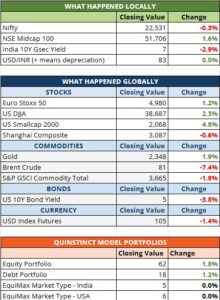
Corporate India has done well, over the last financial year. We are seeing upwards of 20% earnings growth over the year for the Nifty companies, even as valuations have remained high, but not euphoric.
On a macro level, we again see that consumption (as reflected in sales growth of companies) have weakened for our sample of 235 companies over the last year, even as profit growth has remained robust thanks to expanding margins.
The slack in consumption has been taken up by government spending and investment, which now has greater room this year, thanks to the record ₹2.1 lac crore transfer from the RBI to GOI. We believe that this would be (hopefully productively) spent, rather than decreasing the fiscal deficit, which may mean tougher deficit targets for 2025-26.
In summary, to use a cricket analogy, the pitch (unlike the US T20 World Cup ones) looks good, batsmen are set. We are ok as long as we don’t get carried away and expect too much, or allow set-backs to make us overly fearful.
Our Market Type still hovers on the 4/5 border; we would look at a significant reallocation only when this crosses into a 6, or events of significant impact (not elections or budgets!) rear their heads up.
This, of course, depends on the ranges recommended by your risk profile. If you have not done the risk profile questionnaire in the last year, may we request you to do so at the earliest opportunity by going to https://report.quinstinct.com/riskprofiler.
On the fixed income/debt side, we have had a positive outcome of the RBI’s transfer to GOI with 10-year GSec yields coming briefly below the 7% mark and hovering there. We still believe that debt can provide good returns, maybe even better than equity at some point over the next two to three years.
Debt investing is likely to be far more rewarding than it has been between 2020-23.
Did you find this useful?

Thank you for your submission! A verification email has been sent to your inbox.