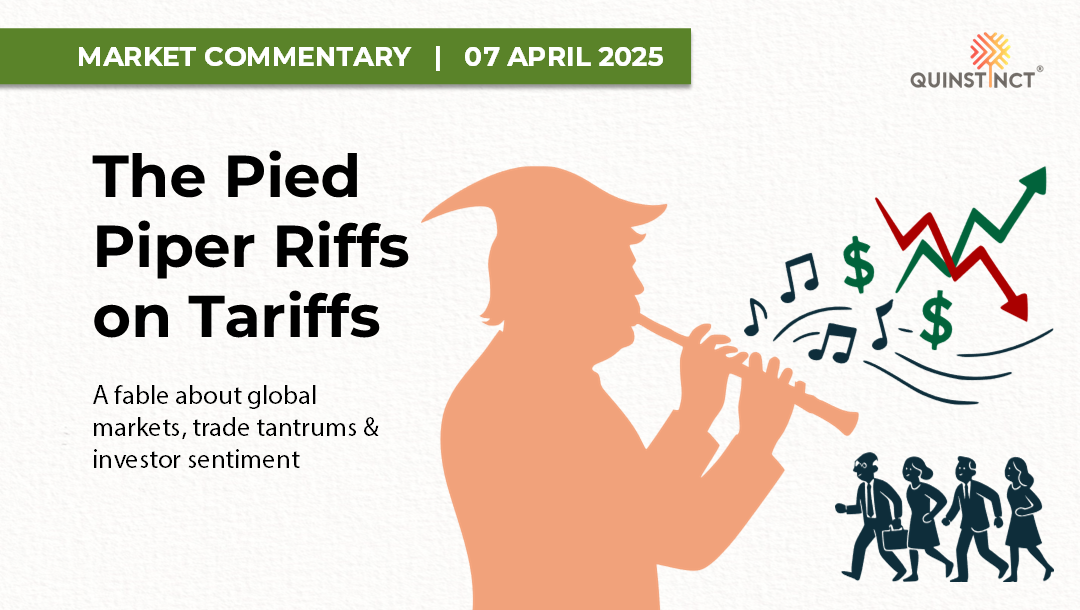
After markets seemed to take heart from the silver linings we had outlined in our March 1 webinar, with the Nifty going up by 6.3% over the month, all gains have been surrendered in the chaos resulting from Mr Trump’s tariff announcements on April 2.
At the time of this writing (April 7, 2:19 pm), the Nifty is at 22,000, which is slightly below the Feb 2025 close.
Essentially, the first few trading days in April 2025 have negated all gains made in Mar 2025, rendering the equity indices part of the table alongside almost irrelevant to this note.
The mid and small cap indices are a little above their Feb 2025 lows.
| WHAT HAPPENED LOCALLY | ||
| Closing Value | Change | |
| Nifty | 24,751 | 1.7 % |
| NSE Midcap100 | 57,420 | 6.1 % |
| India 10Y Gsec Yield | 6.20 | – 2.4 % |
| USD/INR (+ means depreciation) | 85.53 | 1.1 % |
| WHAT HAPPENED GLOBALLY | ||
| STOCKS | Closing Value | Change |
| Euro Stoxx 50 | 5,367 | 4.0 % |
| US DJIA | 42,270 | 3.9 % |
| US Smallcap 2000 | 2,066 | 5.2 % |
| Shanghai Composite | 3,347 | 2.1 % |
| COMMODITIES | Closing Value | Change |
| Gold | 3,315 | – 0.5 % |
| Brent Crude | 63 | – 0.5 % |
| S&P GSCI Commodity Total | 3,567 | 1.6 % |
| BONDS | Closing Value | Change |
| US 10Y Bond Yield | 4 | 5.5 % |
| CURRENCY | Closing Value | Change |
| USD Index Futures | 99 | 0.0 % |
| QUINSTINCT MODEL PORTFOLIOS | ||
| Closing Value | Change | |
| Equity Portfolio | 69 | 4.8 % |
| Debt Portfolio | 20 | 0.9 % |
| EquiMax Market Type – India | 4/5 | 0 |
| EquiMax Market Type – USA | 6 | 0 |
The fall of April 2025 is nothing to do with current fundamentals; the concerns are more around
What does this less-than-logical implementation of an idea with a reasonable goal (bring manufacturing back to the USA) mean for us as investors, and how are markets likely to react, going forward?
First, we have to understand that at this stage, there are only fears, and they are blind. Nobody knows at this stage what the effect of these tariffs are going to be, or whether they may, at some stage be ‘walked back’. Mr Trump seems to believe that he is on the right path (Lesotho notwithstanding), and that his actions will revive American manufacturing.
How this perception survives against the reality of Americans facing losses in their stock portfolio due to his actions remains to be seen. We, of course, have been seeing a Market Type 6 in the US markets for a long time, and maybe this is the much needed reality check that US stocks have to go through.
In our view, Mr Trump’s politics are about the art of the deal- or more importantly communicating that he is winning, whatever the reality.
If (as they already seem to be), countries line up, slashing their import tariffs, and start signing bilateral trade agreements with the USA, this could be spun into a win, and a more sensible tariff regime, one that will not cause fears of a global recession, can be implemented, without it being seen as a ‘walking back’ of aggressive actions. We believe that most of the US trading partners (except maybe China) would opt to pursue this course of action.
In this scenario, over the next few months, as more agreements are signed and tariffs rationalized, the current risk-off sentiment of global capital can turn to risk-on, and it would be economies with a strong domestic base like India, that benefit first from the change of sentiment.
In the interim period, markets are likely to be volatile, with a tug of war happening between optimism (stocks available cheaper) and pessimism (Mr Trump’s actions will cause global recession).
Investor expectations are for a second reduction in the benchmark repo rate by 0.25%, which should bring it to 6%, from 6.5% prior to Feb 2025.
We can also see the effect of recent action on both the USD/INR rate (a 2.2% appreciation over Mar 2025), and bond yields (both India and US 10 year bond yields have come down).
These are conditions that can create an upside with interest rates declining, which can be captured optimally by some allocations to the Dynamic Bond category, with the balance being in safer AAA oriented medium term bond portfolios.
Our recommendation is to focus beyond this immediate compelling noise and understand that India is better positioned than most major economies to offer relatively better growth, and that should attract capital flows, once some sanity prevails.
This would mean holding on to current positions, and if the risk profile limits permit, adding on to equities in a staggered manner through SIP or STP over the next few months.
We therefore would continue to recommend a majority of fresh allocations to both AAA-oriented medium-term debt funds as well as Dynamic Bond Funds.
Arbitrage funds (given their current good yields and tax benefits), could also serve as a temporary holding space for asset allocation rejigs.
Did you find this useful?

Thank you for your submission! A verification email has been sent to your inbox.